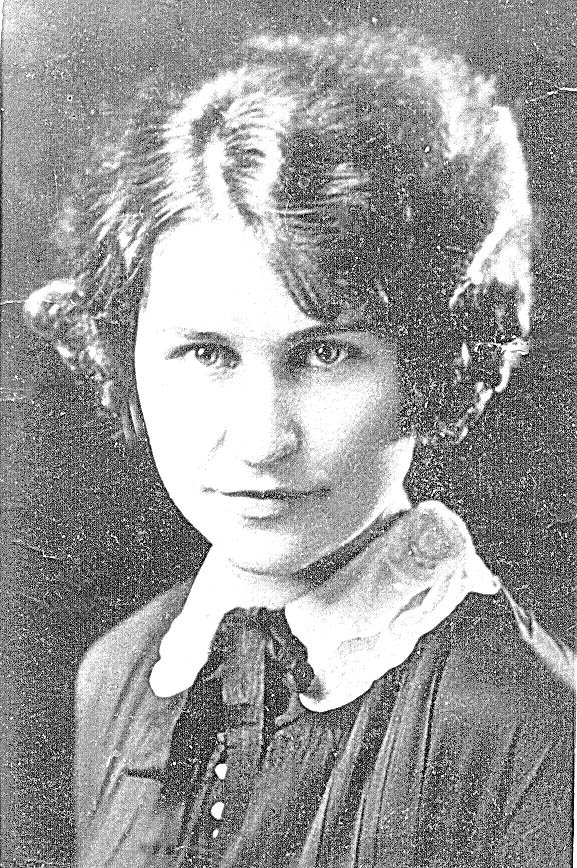
X
Leaving the Farm

Frank
(1900-1975) cherished no
pleasant
memories of farm work, which had not changed much since the family
settled in Tennessee. Yet plowing, hoeing and tending the stock
remained the first order of the
year in Texas as well, and school accommodated itself to
the planting, growing
and harvest seasons. Sunday was a day for the better families to dress
up
and socialize at church, but even on Saturdays
the men would
spend the morning "down at the place," doctoring the cattle, tending a
crop, pruning or budding fruit trees. Frank always remembered
how
the boys could not go to town that afternoon until they had first collected a tow sack
full
of
Johnson grass roots, that being the tall, sharp bladed grass
which
overgrew the cotton and corn fields.
Of a Saturday
afternoon they could "go into town." The nearest
mercantile
community was Gorman. The general store here was more specialized
than that run by their great grandfather back in Flynn’s
Lick. Here it was
Higginbotham’s,
which carried hardware and farm implements only. Grocers were
separate,
although still a credit business. Since the automobile had now
made
its appearance, groceries were often delivered. Out this far west, almost no roads were paved as
yet,
but Frank put some of his first money into a Stuts Bearcat. His
older
brother sold Fords. There was a railroad depot and a post office,
farmers
and cattlemen stood around on the street exchanging news and views, doing deals.
Their wives might be in the shops "making a trade" for a bonnet or for
dress material. By
Frank's time there was even a corner drug store with
a
soda fountain and little metal chairs and tables with imitation marble
tops.
Going into town on Saturday was the family outing. There
might even be a medicine show or a traveling carnival.
Frank started, but did not finish
the eighth grade.
That was already more schooling than enjoyed by anyone before him in
the family.
He had what they called "good business sense" (a more comprehensive
understanding of law and accounting than most educated men of my own,
better schooled
generation). Arithmetic culminated in the "rule of three," what we
learned as proportions, or ratios. For Frank it was a nifty way
of solving all kinds of tasks. The idea was
to arrange
any problem as a/b = c/x.
Being
good with figures, Frank took a job in his
grandfather's
bank while he was still
a teen-ager. A half century later, he was still
able (at
my request)
to sign his name with the beautiful scroll-work affected by such
responsible officers.
I have a picture of his
grandfather's banks in Duster and in
Desdemona. Today the former has been removed to a nearby park,
and Desdemona is reduced to just a few houses on the
east side of Hog Creek. In the
oil boom years 1918-1921, "Hogtown" was a fair sized
collection
of shanties on rutted streets populated by land speculators, oil rig
equipment vendors, ox train drivers, gamblers, prostitutes, and general
hell-raisers.
Among the
latter was Frank's maternal uncle and namesake, the highly successful
bully and
gambler Frank Kirk. Upscale
entertainment might be a traveling badger in a barrel, whose owner
offered a prize to any dog that could bring him out.
John Casper Kirk and Drusilla née
Thompson are
buried in Weaver Cemetery just west of Gorman. Their son and daughter,
Frank and Laura Ann, married Haile siblings (Laura
Ann named a son after her brother). The
children were "double cousins," a frequent phenomenon in unsettled
and
desolate territory where families sought association with others
of
a similar raising.
I have no knowledge of the Kirks before
they came to Texas. Laura Ann had two older brothers, Lee and
John. Quite unlike her younger brother Frank, Lee and
John were sober farmers
and ranchers. Lee and his wife, Aunt Ninny, lived "next door," at
about 100 yards from Laura. They had six sons and a
daughter. Two
of the sons became bank presidents, one a district judge, one an
admiral. In these boys one might see an ideal transition
from traditional agrarian culture to the new commercial world.
But of course I best remember
the youngest, the hellion who made his fortune in wildcat
oil
drilling. Frank Kirk's
enthusiastic followers included the
roustabouts, mule skinners and ox drivers dependent on him , but also
his own teenaged son Arnold and his sister's boys Aaron and Frank
Haile.
I
remember all of these men. Erin
( christened Aaron) had thin auburn hair (which he dyed), was
clever, witty, a charmer and fancy dresser who boasted that he had
never done a day's work
in his life. He drove a Packard or a Lincoln Zephyr, had rings on
his
fingers and a lady at his side, a blustering,
likable, dishonest ne'er do
well.
Arnold favored the Kirk side of the family. Huge, red-headed,
freckle-faced, curly red
hair
all over his body, boisterously good-natured, he was a perfect
throwback
to the ancient Celts. A crisis I remember from my childhood was
when
Arnold was shot. The story went
that
he had accused a man, or had been accused, of irregularity in a card
game. Arnold was advancing upon his adversary, knife in hand, refusing to stop
despite
being struck five times in the chest by bullets. Arnold survived. I do
not
know the fate of the shooter. Arnold followed his father’s
example of
wildcatting
for oil, and became the proverbial wealthy Texan. His wife appeared in
Time magazine as the owner of
a stunning diamond necklace which spelled
out
in precious stones a highly improper word across her décolletage.
It just may be that something of the
old cavalier is
still perceptible in such fellows. They were swashbucklers, carrying
and
carried by good nature and self confidence, always ready for a scrap,
however ill-prepared. Obviously, their line had by this time survived
some pretty tough transitions, yet they individually seem never quite
up to
it, holding to their rambunctious
ways. My own father was one of those with whom the times had caught up.
He was an experienced cowhand, a good companion. He had a fancy
signature, a Stuts Bearcat Roadster, a fur coat, and a pin-stripe suit,
but no credentials beyond the rule of threes, "a smile and a shoeshine." More was not really
needed in the
prosperous, expanding 1920s.

Perhaps having subsequently become more ambitious,
Frank joined his brother Rudolf at the Haile Airport
in Austin (you can still call it up on
the internet). There was money to be had "barnstorming,"
giving
instruction, or just taking sightseers up for a flight. Crashes
were not unusual, Rudolf was injured in two.
It was a
dangerous way to make money, and Nell put a quietus to it. Frank
returned
to traveling for finance companies, then for the farm implement
companies Oliver and John Deere. When I was a little boy he was
employed by Bull Stewart, distributor of the new Ford Tractor,
which attempted to replace the traditional massive weight of the
tractor by use of a sophisticated hydraulic system. Frank, a
naturally enthusiastic man with sentimental attachment to agrarian life
and was especially gifted with "a smile and a shoeshine" for dealing
with people, worked
as jobber between distributor and dealer.
America's economy had much
deteriorated since Frank had entered it. By the time he had a
growing family the Roosevelt "Great Depression" had fully set in, and
the radical statist intervention popular world wide in the 1930s kept
making things worse. With the war in Europe, however, aircraft
factories were established in Texas cities. The many of the
nineteenth and early twentieth centuries had left the country with a
military quite inadequate to President
Roosevelt's antagonism with Fascist ambitions overseas (although
American bounty was generously supplied to the Communist Soviet
Union). The importance of air combat had been made clear while
Frank was still in his teens--and he had acquired some experience in
that
area. When war came to Europe the Roosevelt administration set
about aircraft procurement. Frank was prompted to open an
"aeronautical trade school" in Houston, which gave an edge to people
hoping for jobs in
the
booming plants in Dallas and Fort Worth. It taught simple skills
like
reading
blueprints, using electric drills and rivet guns. Soon he opened
a
second
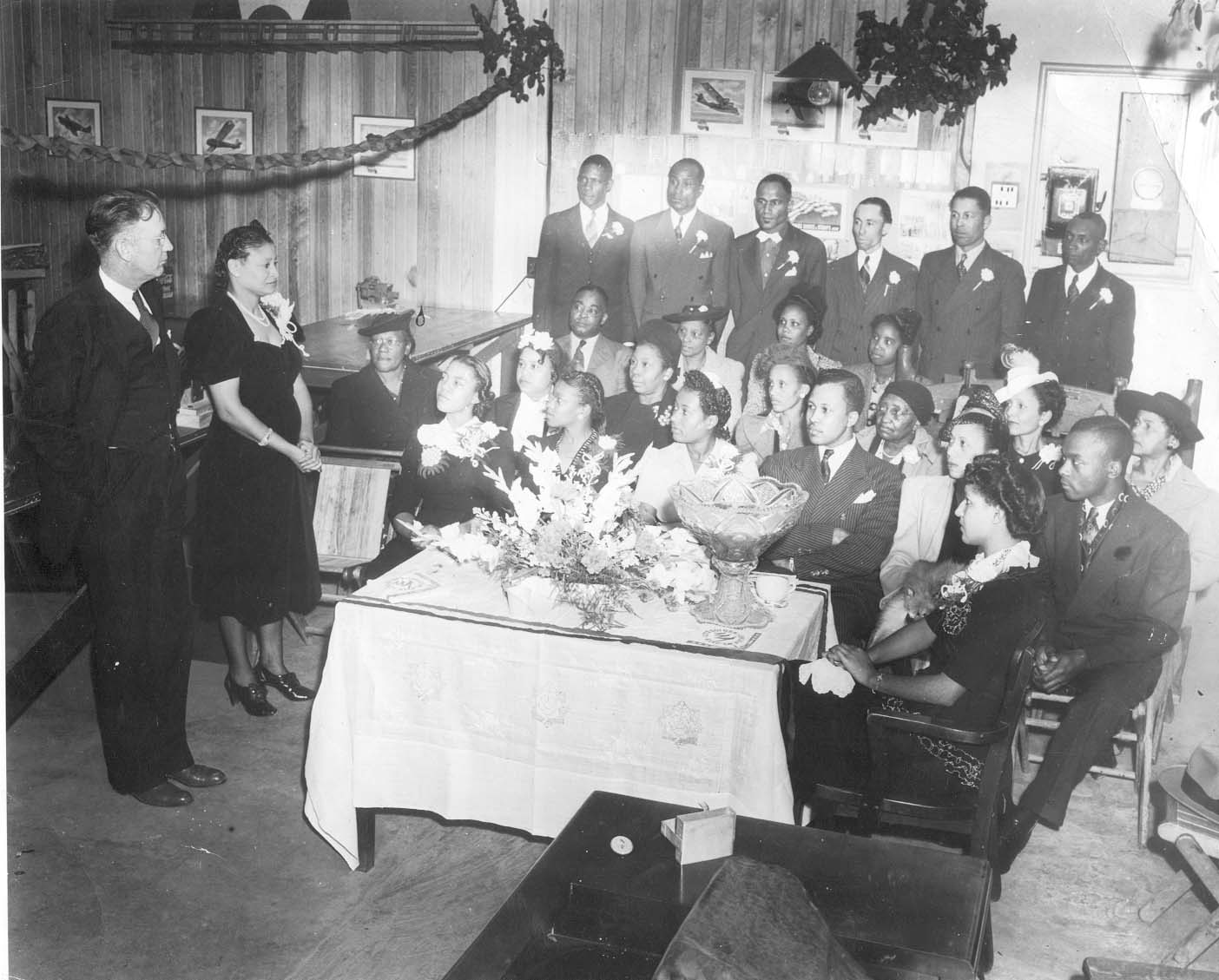
school for Negroes. Here is a photograph of my father at a
graduating ceremony. It may not appear
so unusual
today,
but was in fact quite remarkable during World War II.
After the war, demand for
aircraft workers white or black fell rapidly.
Frank had got enough ahead to buy into a Ford Tractor dealership in
Texarkana. Whether this move reflected the fertility of the Red and
Sulphur River bottoms, or Nell's fondness for "home" would be hard to
say. This was still the era of family farms, for which the
light-weight, Ford-Ferguson was ideal. We moved into Nell's
girlhood home, the
old Tom and Molly Goodson house pictured earlier. In Texarkana he
accumulated enough capital
to buy ou tright the Ford Tractor dealership in Eastland, Texas, the
major town just a few miles from his boyhood home, where his mother
still lived.
It turned out to be a catastrophic
move. His attempt to return to his roots in the dusty
home territory
was
foiled by the terrible drought of 1950-54. It was not so severe
back in the East Texas and Arkansas woodlands, but many of the farmers
in the Cross Timbers and further west were ruined. No longer a
young couple, Frank and Nell sold their home in Eastland and moved to
the new metropolis Houston. He was able to work as an accountant
and she could unroll her impressive diploma from the College of
Industrial Arts, as well as her Arkansas teaching certificate.
When she retired, they moved to Dallas to be near her siblings. They had retained a peanut farm they had acquired in better days at Desdemona.
They kept it leased to peanut growers. Frank frequently
drove the hundred or so miles to Desdemona to take care of details like
irrigation and covercrops. He even acquired a horse he could
visit and offer an apple when he was there. A victim in his last
years of Parkinson's disease, Frank finally had to forego even that
little pleasure.
I suppose I
inherited my father's
sentimental
attachment to that rainless sand, but in the years after his death I
gradually
disposed of the peanut farm he had bought and finally even of the rocky
hill
he had inherited. In the meantime these patches of Texas soil provided the possibility
of a little closer study of that world. One time, when I was
buying
grass
seed, my daughter and son-in-law came with me to
the
Turner Seed Company in Breckenridge, Texas. In discussing seeds with
Mr.
Turner--planting seasons and drought epoch, the general harshness of West
Texas life in general, I remarked that "You killed my old
daddy,
God damn you, kill me." I think Mr. Turner recognized the quotation
(from "Rye Whiskey"),
but
Constance and Richard naturally attributed it to my dotage, and still
do.
As for Texas, naked came we into
that world, and
naked came we hither. R.T. had been able to salvage very little out of
post-war
Tennessee.
One might guess that any culture in R.T.'s Duster, Texas household came
from his wife's family, the Richards of Nashville, Arkansas. About the best one can say of R.T. himself is
that he was enterprising and shrewd. He became a well-to-do
banker and land holder. The same goes for his son
Fate. Although I did attend a Kirk
reunion in a little town near
Eastland, I
know next to nothing about Drusilla Thompson and John Caspar Kirk
(buried at Weaver Cemetery near Gorman). Their daughter Laura Ann was the
ideal of reticent feminine elegance, but she did have spunk.
I remember how she voted "dry" in the Eastland County election on
alcohol sales, in the
face of my mother's superior argument in favor of "wet." Laura
conceded that Nell's reasoning was correct, but stuck to her
own "dry" vote,
because "it is the right thing to do." Lest I depict her as too
retiring,
I record that she was an excellent marksman. I watched her in
her
sixties hit a feral cat in the head with a 22. caliber rifle at forty
yards.
Her
generation still deferred to
their
men, but sustained
them intellectually and whipped them at
dominoes.
Some of my earliest memories are
of my grandmother's
elegant parlor where she and her brothers Frank or sometimes John
or Lee, and usually her sister-in-law Pearl sat at the ivories,
patiently clicking them
over and over.
"Six-five'l make fifteen, John." "Your down Laura." I was
given black wooden dominoes with which I built oil derricks beneath
their
table. On my horizon might be a red Folgers coffee can where
someone spit tobacco juice, or my Aunt Pearl's cloisonné
receptical for snuff juice. Sometimes Pearl (Fate's sister) had a pint fruit
jar of
prickly pear juice at her side, which she regarded as very healthful.
Pearl had a kind of white parchment face, but
ruddy cheeks, and thin auburn hair drawn so tightly back into a knot that it
made her squint. She spoke hard language ("Take a stick a stow'
wood atter her." "Snatch that bitch bawld headed.") and was quick
to use her good natured but forceful husband to get her way in
her little town of Gorman. What a contrast with my pious and proper
grandmother, a
studious Bible reader.
Unlike his own father, mine was gentle and
especially
protective
of his son. I suppose the best Frank did by me was to
marry
into literacy, and to revere it. He loved to read, but mostly
together
with
my mother. So far as I know, literacy is a quality which no
previous
generation of Hailes had shared. Might this history
have done
better
to pursue the literate Goodsons or the Cranks or the McClures a little
farther
back? By and large, they were less well to do, so that their record
is
more
obscure. --Why, you may ask, do I count literacy so important? I think that the Hailes did not really lack ambition. On the
contrary,
they are a hard-working, enterprising line. It is just a shame their
aspirations
were so limited. Yet how could they have aspired to more? What did they
know? Frank obviously
knew
that his was
a century of technology--he had his sports car and flew his
biplane. I would guess it never occurred to him that Werner
Heisenberg and Robert Oppenheimer were his
contemporaries.
Nicholas the chapel builder in
Baltimore seems to have been
receptive to a
higher
calling. He lived at a time when popular evangelistic fervor had made the riches of ancient Hebrew culture accessible,
for a brief
moment. As to Nicholas's Dustbowl offspring, however, what did
they know
to aspire
to?
To put it perhaps more harshly, what had they
to
say
to one another? Well, they could speak of everyday objects and
concepts,
after the fashion of Caliban. Language is a wonderful metaphor in
itself, but its ultimate transport is beyond the common and
the immediate into the
memorable metaphors of our three-thousand year written heritage.
Writing even permits us to probe beyond writing, into prehistory.
Without
our books we live
hand to
mouth, in the shallow day to day. Without books we are zombies,
at best. At worst, watchers of TV and video games, toys of
tyranny.
Frank's family was the
product of
four centuries assimilating the
vast American continent, a dozen generations on frontiers, from the
Tidewater westward. The old cultural treasures had been too heavy
for the
oceangoing vessels of the seventeenth century, and far too burdensome
for the trek across
mountains and forests and deserts in the New World. A chimney
sweep
who remained in London might still have had some inkling of that world
of
intellect,
be it only at a longing distance, the child of the dustbowl had only
his
Bible. However expansive and inspiring the Great Plains, literacy
was the only window on civilization. The
Hailes,
by the time they had made it out to Texas, and had made it in Texas,
found
themselves in woefully narrow surroundings. Yet of about the same
age as Frank
and his siblings were the sensitive writer
Katherine Ann Porter, born not
forty miles south of the Sabana, and the astute historian Walter
Prescott Webb, who grew up about twenty miles to the north. So a leaven
remained, and no doubt still
does today, in my own even less literate, pitiable world.