This page has been revised.  Please click here
    < PREVIOUS
Flynn's Lick, Tennessee

        Thomas Francis (Jan.7, 1816-Jan. 9, 1865) was partner in a store in Flynn's Lick.  He married Elizabeth Gipson, whose family still lives there.  She lies just off the road south of town, looking out over a deep valley to the mountains beyond.  Thomas Francis remained in the prison ground at Camp Chase in Columbus Ohio, where he had died of pneumonia at age forty-nine, his grave marked with a stone to "Tom Hale."  The story goes that the local resistance in the Cumberland Valley had received supplies from the Haile store.  Federal soldiers are said to have come to Tom's home and taken him away in chains.  This story is credible, as Camp Chase was originally used for political prisoners only.  Before the war was over, every prison was crowded with all sorts, and by war's end had become unspeakably fetid and filthy and disease-ridden.  Few survived.  Tom's son remembered carving the family name on his father's coffin.  He also recalled his father's last words to him:  "Always tell the truth, Tom, to a hair's breadth."  Those words must be pronounced with the dark, almost diphthongal "Towm," and the somewhat open "hahr's brayudth."

        Here are a few scraps from Tom's business dealings.  
Lest the sums involved seem insignificant, one would have to multiply them by 25 in order to approximate 21st-century "buying power."  During the runaway inflation of the early 1860s, that factor was reduced roughly by half, to say 12 or 13.  During the rest of the century the dollar rose in value until we again need to multiply by more than 20 to get an idea of our equivalent.

The first note reads:

$125.  One day after date I promise to pay Thomas Hale One Hundred and Twenty five Dollars One half of the debt the Bank of Tennessee had against Charles Hopkins.  for valueRecd.
this April 4th 1859
                            Thomas F. Jones


The second reads:
$16.00
        One day after date I promis to pay Thomas F. Jones sixteen dollars for value Recd.  this note which is be credited on his Blacksmith acct with me [?] in the [?] Year [?] 1858 of this Febr 22 1860
                                                    Thomas Haile (seal)
                                                    Joshua Haile Jr [?]


The scrap above reads:
    Flynns Lick Ten.
            Sept 28 / 59
Twelve monts from the 25 of December next I promis to pay Jones & Haile Six hundred dollars for val. recd of him [scratched through] this Sept 28 / 59
                                    Thos Haile (seal)


        Speculation as to the identity of the cosigner above leads us to interesting articles submitted to the Smithsonian Institution Annual Report of the Board of Regents in 1874 and 1881 (vols. 29 & 34).  They describe Indian graves near Flynn's Lick, as well as other antiquities found there. 
The author of the 1874 article signs himself Joshua Haile Sr., from Gainsborough, and finds the artifacts at "my place," presumably on Flynn's Lick; the second article is by a Reverend Joshua Haile from Jackson County.  Both contributions could stem from one individual's pen, or perhaps from an older and a younger man ("Jr." was not yet restricted to "son").  Chances are that the Joshua whose signature appears on the promissory note reproduced above wrote the first, anyhow.  He could be Tom's older brother, but might conceivably be a cousin, or nephew--maybe his paternal uncle. The contributions are written in a pleasingly literate style, and may today be less valuable for their archeological content than for their depiction of the postbellum Cumberland River Valley.  One reason the identity of the author is unclear is that filial piety toward the Joshua who fell in the War of 1812 initiated another naming tradition in the family.  There were still numerous Nicholas Hailes (Amon's daughter Nancy nče Haile lies in the Gainsborough cemetery beside her husband, Nicholas P. Haile), and there continued to be scads of children from the fiery furnace.  Tom's widow, Elizabeth, was represented by her son, the Livingston, Tenn. attorney Joshua Haile Jr., when the family disputed her bona fides in connection with her purchase of acreage from her father-in-law (Elizabeth claimed that she had already paid Amon in gold just shortly before the old man was caught in a storm and killed by a falling tree, but before he executed her deed to the place).
  .      
        The generation who endured Mr. Lincoln’s War was surely a disturbed one. 
Elizabeth's immediate family had been devastated.  She had lost her husband and at least one son.  Another son returned an emotional cripple.  Others of her children left Tennessee for good.  My generation sometimes looks back on World War II as history's most terrible conflict, beginning with the "holocaust" and ending with "armageddon."  In terms of lost American lives, the Civil War was much worse.

        World War II killed some 407,316 young Americans. 
The Federal Army who invaded the American South itself lost nearly that many, 359,528, while 198,524 boys died resisting them.  One must not just add these numbers, but place them in context.  Assuming that males between sixteen and forty-four (the ages of young Tom and his father) made up some 7 1/2 % of their home populations, we could say that World War II took forty young men from every thousand: 407k/(133m x .075), while the invasion of the South cost five times that many: 360k/(22m x .075).  As to the Confederacy, with fewer than nine million in 1860 (including slaves!), those 198,524 deaths were about a third of all the young men: 199k/(9m x .075), or 294 per thousand (but a much, much higher percentage if we were not here including the black population among fighters for the South).

        That only begins to tell the story, for this was a new kind of war, a war against the population.  Mr. Lincoln's was the first modern invasion to renew the ancient terror last visited by Julius Caesar, upon the families, their children and their means of subsistence. 
Disavowal of the savage doctrine vae victis had been the slow triumph of Christendom over the centuries.  By the eighteenth century, the sanctity of civilian populations had at last become firmly ingrained in the military mind and culture.  President Lincoln's reinstatement of total war had far reaching consequences, e.g., against the Indians, notoriously at Wounded Knee in the winter of 1890.  It may be argued that the behavior of those troopers was not planned by their officers, but Curtis LeMay's carefully devised firestorms in population centers, 1944-45, clearly represented long-term United States strategy.  Nor has the 21st century seen the end of terror as policy.

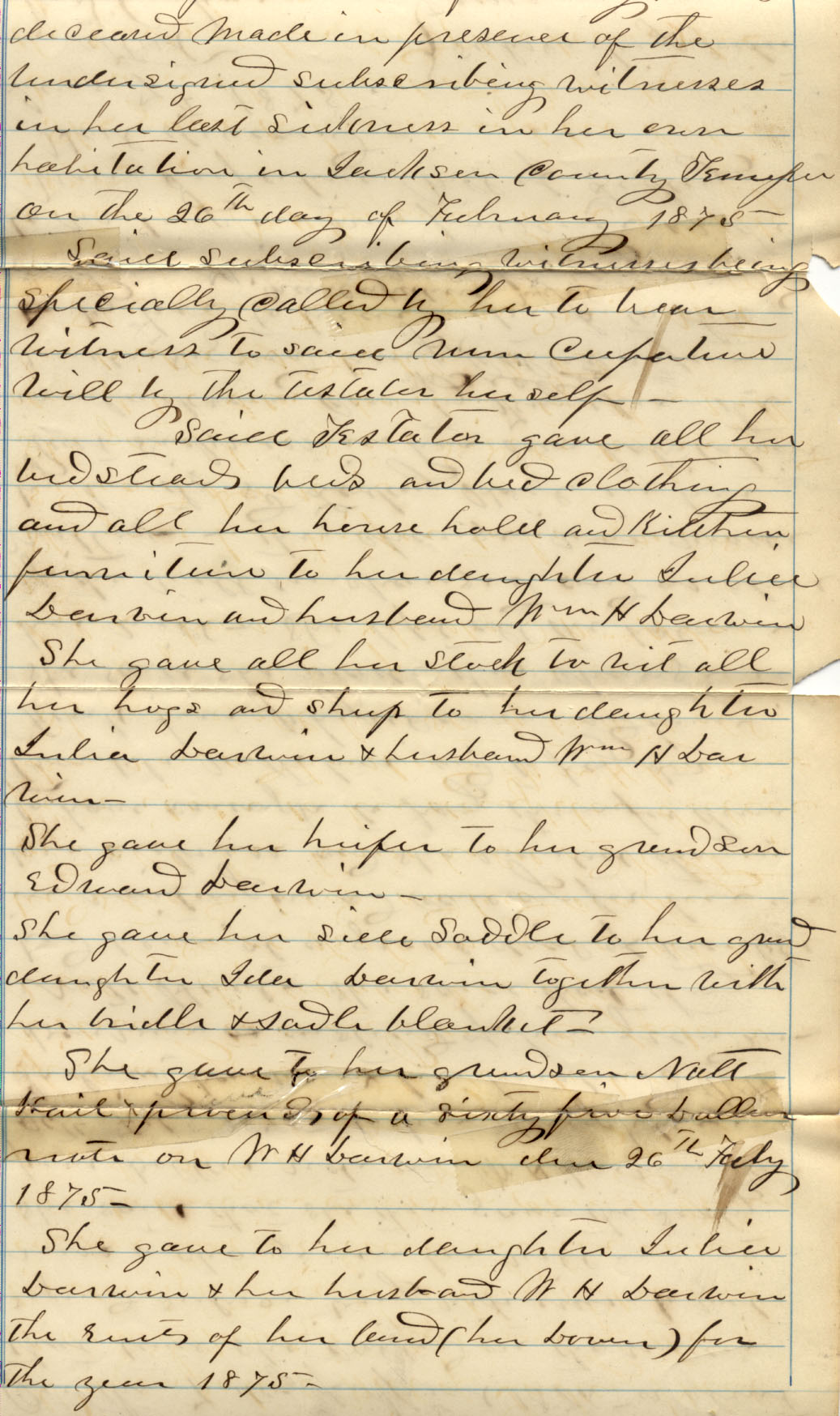
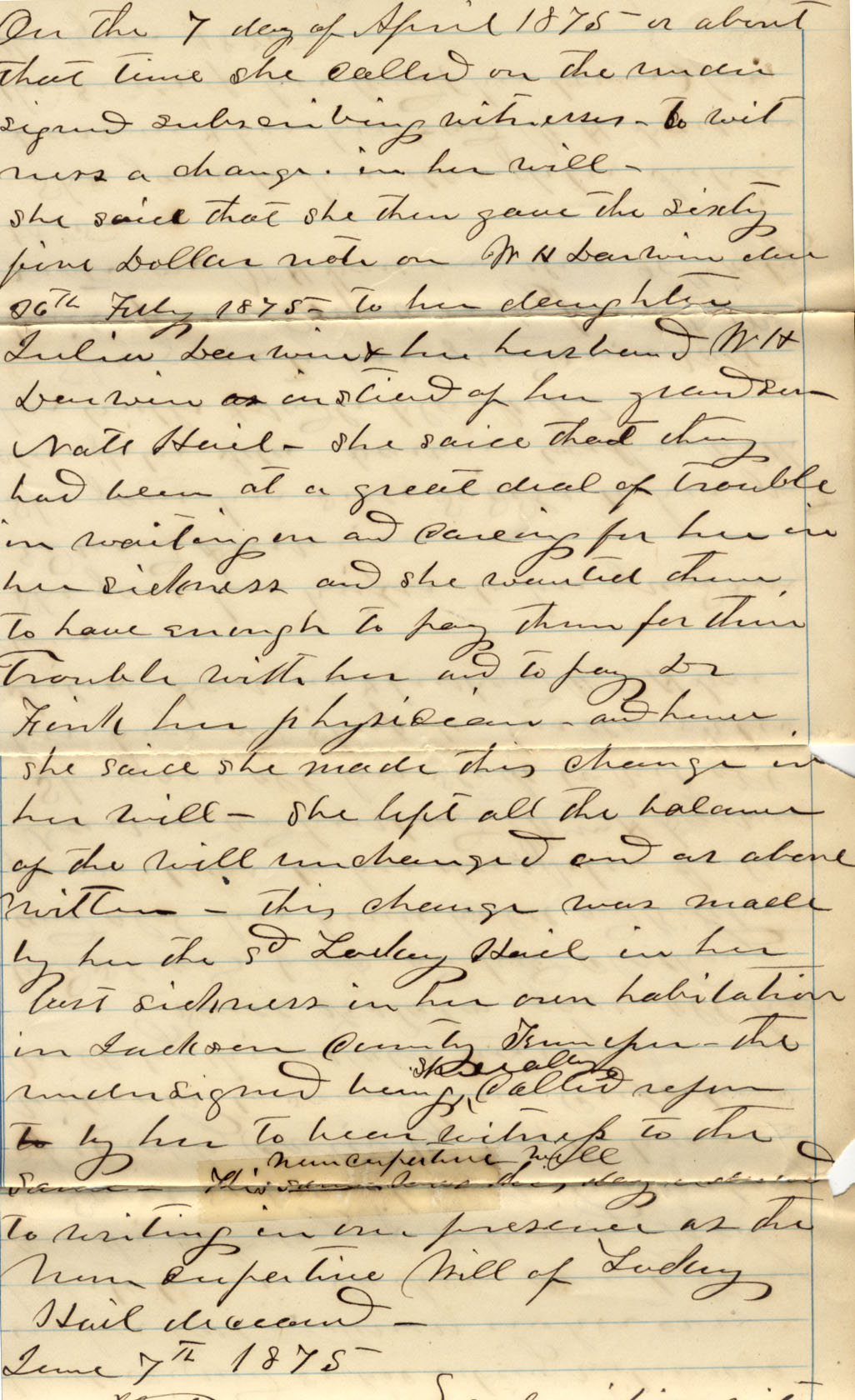
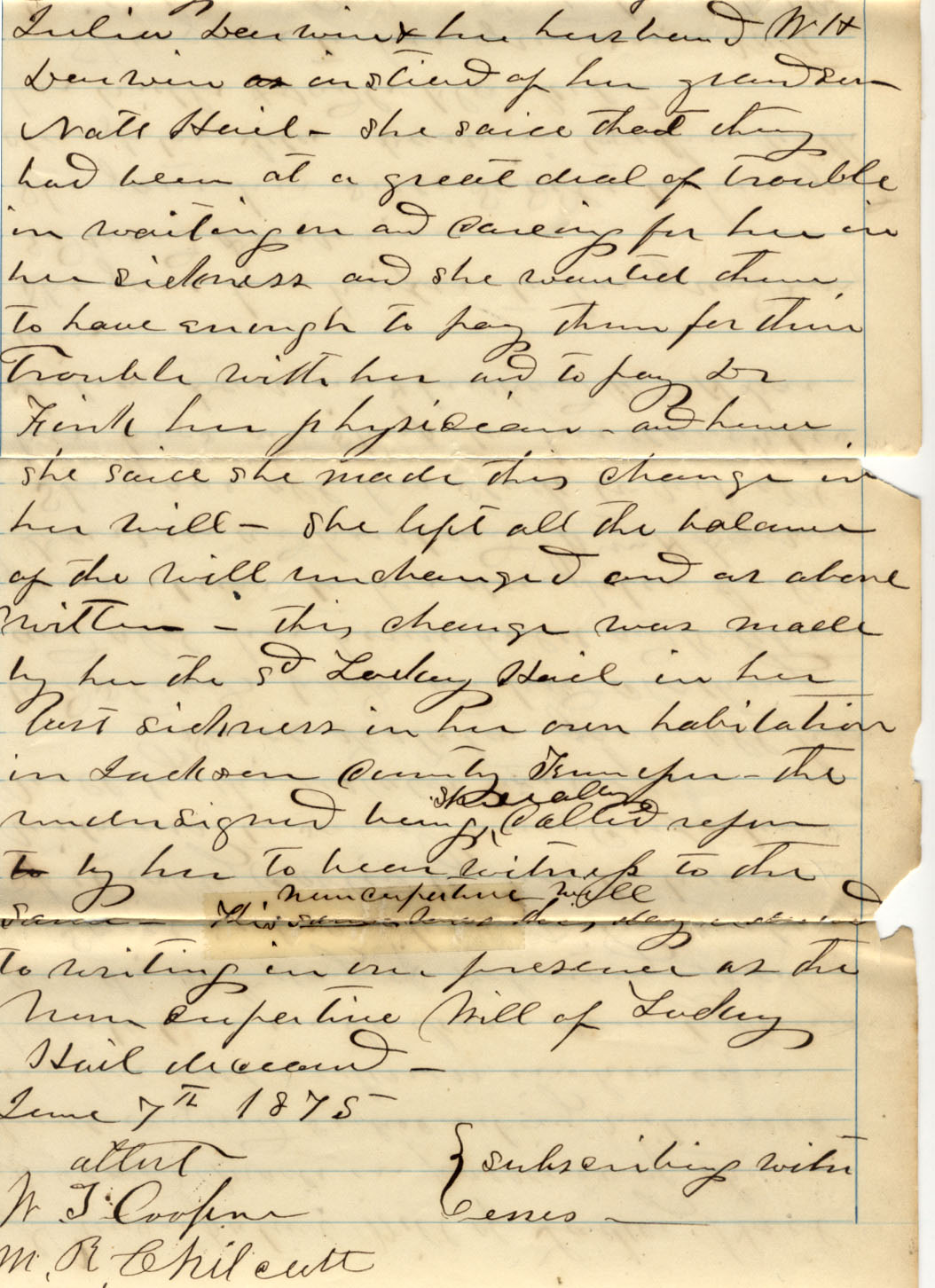
        At the middle of his century, and by his own middle age, Amon Haile had been a prosperous merchant planter in the beautiful Cumberland valley.  His own fortune, like the lives and health of his children and grandchildren, had obviously been ruined by the invasion.  As Hailes had by this time become numerous throughout North Carolina, east and middle Tennessee, heaven only knows how many casualties the extended family must have suffered.  Amon's own material circumstances after the War happen to be  illuminated by court records arising from his accidental death during a storm in September of 1867.  Earlier that year, in order to pay off some debts, Amon had sold a piece of land to his daughter-in-law, Tom's widow, Elizabeth.  This resourceful woman,  still running her husband's store, was able to make a substantial down payment in gold, as well as with a sorrel mare.  Her son Joshua was to draw up the papers on his next visit home, but Amon's death intervened.  The complicated court records preserve information about the family and the times.  Most touching is the auction of Amon's household goods and farm implements to neighbors, to family, and even to his own widow.  According to Tennessee law, Lockie retained the dower, and so may have had enough rents to live on.  In her last years, she was cared for by her daughter Julia and son-in-law William Darwin.  In addition to some land and its rent, her estate consisted of a few hogs and sheep, household goods, and a $65 note owed her by the son-in-law (figured in 2004 purchasing power, it might have been worth about $1,000).  Lockie would really like to leave that money to a grandson, but then decides against it for reasons which seem all too easy to divine.

Lockie's will

[p. 1 top]


[p. 1 bottom]


[p. 2, top]


[p. 2, bottom]


(Amon and Lockie are buried at Brown's Cemetery, just on down the road from where Elizabeth lies).

    Elizabeth's fortunate family has not suffered from war since Lockie, nor has a mother lost a son to war since her son Tom died in Federal prison.  For any reader who may be equally innocent, I offer a remark of  the already cited Francis Baily, who toured Tennessee while Amon was still a small boy there.  Commenting on the American secession from the English crown, the traveler was so indignant at British destruction of the Princeton library that he compared his own fellow Englishmen to the Goths and the Vandals, then went on to generalize on the horrors of any invasion:  "The conduct of the Goths and Vandals is generally held up as an example of the bad effects and unbounded devastation of an unprincipled banditti; but we shall find that in most countries, when a state has been overrun by an invading enemy, the conquering soldiers . . . are generally made up of the dregs of society . . . and in modern times we have too many instances of both falling sacrifices to their unprincipled habits and inveterate fury." 

    Elsewhere, Baily refers to the American War of Independence / American Revolution as a "fratricidious war."  This is a better term than Civil War / War between the States. 
After this most vicious invasion, the vanquished were not treated as mere losers, but as notorious miscreants.  Vae victis!

 NEXT >

Contents                                                                                Home


        Of the two sacraments remaining, the Holy Eucharist had been hotly contested for a generation or two,  the "real presence" of Christ in the mass disputed.  By Nicholas's century the focus had been shifted to the other remaining sacrament, baptism.  The Reverend John Smyth (d. 1612) insisted that this rite of  initiation into Christianity must occur as a considered act, indeed as a fundamental transformation of the self:  becoming a Christian must be a rebirth.  On the American frontier Baptists insisted on total immersion.  A Pennsylvania Presbyterian, Alexander Campbell (1788-1866) rejected infant baptism, called his denomination simply the Church of Christ, would abide only one book, the Bible, and accept no model olther than the original apostles.  One of Nicholas's offspring was to be drawn up into the Campbellite movement.


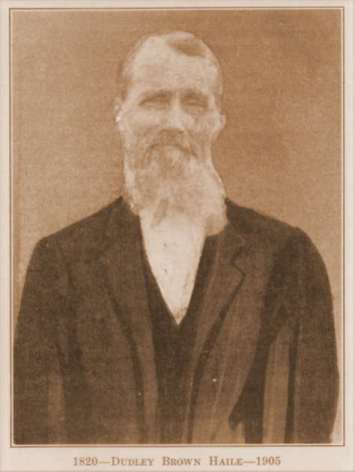
Although Dudley Haile was a full-time farmer and made his entire living from the soil, he was celebrated in Tennessee for preaching the Gospel according to the Campbell doctrine.   Dudley's great grandfather had founded a Baptist church in Watauga.  His great, great grandfather was Nicholas of Bedford.