Before the move,
Nicholas (at the age of
sixteen, if
Crowe's date is correct) had married Ruth Acre, but their first children
(Richard, Elizabeth,
and William, and Sarah--Crowe, pp. 62-65)
were born
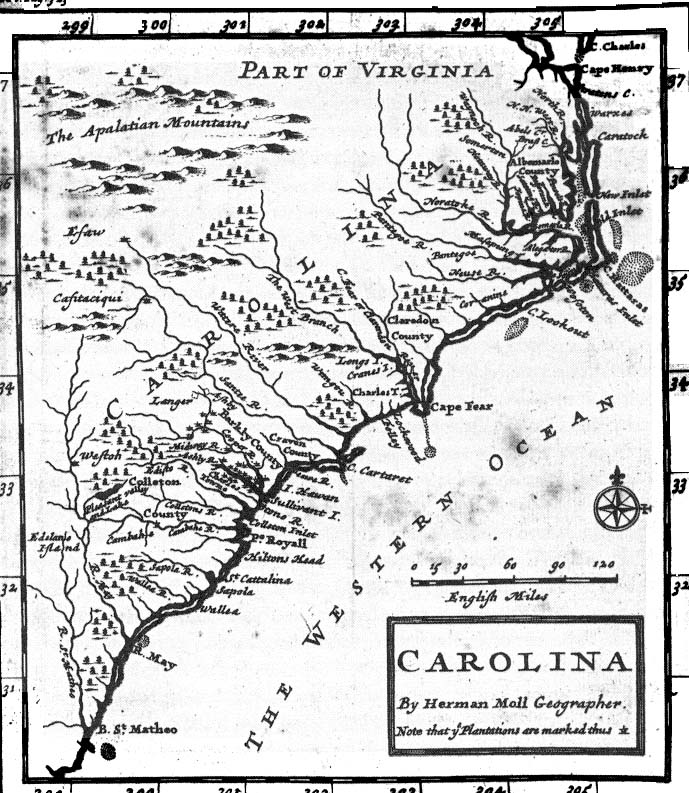
in Virginia. From there, young Nicholas and other members of his
family (the
Talbots, for example) migrated yet farther south to Rowan County, at
that
time
still a part of North Carolina. Three more
sons were born, Nathan, Amon and, yes, a Nicholas.
But by this time troubles
with
England were disturbing the colonies. In 1765, the notorious
Stamp Act, and then the
Quartering Act (which required colonials to provide housing and food
for the Redcoats) had provoked the calling of the Continental
Congress.
In 1767, Parliament levied the taxes (the Townsend Act) which set the stage
for the Boston Tea
Party. The backcountry families
of the Carolinas were
among the first to
lash out
against corrupt
English
practices. The Carolina Regulators, instituted to maintain order,
were opposed by the
governor of South Carolina. In 1771,
after the elaborate English fashion of hanging,
drawing and quartering, he executed their
leader, Benjamin Merrill. The
Watauga Petition of 1776, sometimes referred to
as the first American Declaration of Independence, was an early effort
toward self government. Nicholas's nephew
(his brother George's
son) is the John Haile (born
1743 in Baltimore, Crowe, pp. 38 f.) who turns up as signatory to
this document. John then
fought
(together with Matthew Talbot) at King's Mountain in October of
1780. This decisive battle was
between Loyalist and Patriot colonials--Americans on both sides.
John Haile and Matthew Talbot fought as Patriots. Needless to
say, their
forebears
had been loyal to their king.
Nicholas's own son Shadrach (b.
1735, in Baltimore),
along with Shadrach's son of the same name, were signatories to
the
Franklin Petition of 1787, for an independent state. The
elder Shadrach can sign his name,
but the son must mark with his X. By this fourth and fifth
generation
on American soil, a populace now formally separated from England has
developed its own distinctive character. Although they had called
themselves Patriots, they by no means championed a strong government of
their own. In the same year as the Franklin Petition, they also
refused to ratify the Constituion.
Francis Baily, a young
British
banker, scientist, and scholar who toured America just after the
Revolution, found the breakfasts remarkable, not
so much for the prodigious quantity as for the way all the guests sat
around the same table without regard to rank or station. Even the
prices
seemed indiscriminate:
If
our table were spread with all the profusion of American luxury, such
as ham, cold beef, fried chicken &c. &c., (which are not
uncommon for breakfast in this part of the world), or whether we sat
down to a dish of tea and hoe-cake, our charge was all the same.
The accommodations we met with on the road were pretty well,
considering the short time this country has been settled, and the
character and disposition of its inhabitants, which are not those of
polished nations, but a character and disposition arising from a
consciousness of independence, accompanied by a spirit and manner
highly characteristic of this consciousness. It is not education
alone that forms this character of the Americans: it stands upon
a firmer basis than this. The means of subsistence being so easy
in the country, and their dependence on each other consequently so
trifling, that spirit of servility to those above them so prevalent
in European manners, is wholly unknown to them; and they pass their
lives
without any regard to the smiles or the frowns of men in power. (p. 42)
Baily himself
retained his strong British class consciousness, and was especially
sensitive to the rude and sometimes filthy living conditions on the
frontier. He spoke of three "classes" of settlement where we
might today speak of three developmental "stages," for Baily meant that
the
coarseness of manners, food, and shelter was gradually refined by later
settlers. It seems probable that the Hailes were never really out
at the true wilderness frontier, but may have belonged to the second or
third wave, moving in to occupy lands still relatively cheap but
already cleared of the most vicious Indian resistance, and where a
modicum of cleanliness and regularity was becoming possible.
Nicholas
and Ruth returned to Baltimore. Here at
age 42, Ruth gave birth
to her
last child, Joshua Thomas. Within a few years, three of the boys
(Richard, Nathan, and Amon) were old
enough to join
Washington's
Continental Army. After Independence, Nicholas as well as his
brother George and their by now grown children headed back down the
Blue Ridge for Watauga. The young men who had fought in the
Revolution
had bounty lands waiting. The earliest evidence of the family's
presence
in what is today Washington County is Nicholas's will, dated in April
of 1807. He actually had more than a decade of life yet left to
him, and
would outlive the youngest son mentioned in the will.

top