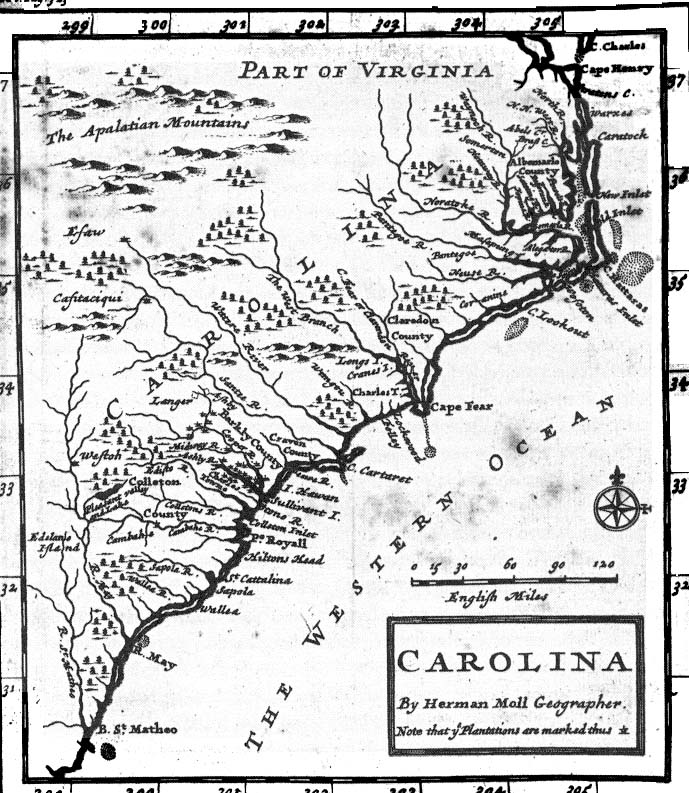
We have come to the fourth
generation of the Hailes in America. Just by chance,
each successive head of household in this particular line bears the
name Nicholas. Here is a good point at which to pause and take stock.
The Nicholas born in England in
the year of the Petition of Right (1628) received land patents on the Corotoman. He died at an early age, in 1672, but his family was now established in Virginia.
A son who
sought his fortune in Baltimore County was granted a long life (1657-1730), while his family became prosperous and well connected in Baltimore County. They were strong supporters of the Church of England and its cathedral in Baltimore Town.
It was a grandson then (ca. 1702-52) who joined the Quakers
in
Bucks County, Pennsylvania and accompanied them to the frontier in Bedford, Virginia. Here he played a prominent rôle, as did especially his associates and sons-in-law. He
died at
middle age.
The great grandson,
Nicholas
of Watauga (1724-1818),
was another to enjoy a long life. This last of our direct line to
bear the name Nicholas witnessed such great changes in America as to stagger our imagination. This Nicholas was born during the reign of
George I, a king who scarcely heeded our fringe of English settlement along a remote American coastline. But Nicholas lived out the reign of George I and also that of of George
II, at last saw George III actually lose the American
colonies. This Nicholas became citizen of an American
republic established on unheard of principles, and chary of any government power. He actually
experienced
the presidential administrations of all four founders, Washington,
Adams, Jefferson, and Madison. Nicholas's
birthplace in Baltimore swelled with new immigrants. His
grandfather, also born there, would scarcely have recognized the new landscape.
For this Nicholas, the
wilderness was
no longer
impenetrable. Opportunities beckoned all the way to the Mississippi
basin. As a ninety-three year old, he saw yet one more
Virginian, also a framer of the new Constitution, assume the presidency of a United States of America. Nicholas
himself, of course, had no idea of such a perspective as ours, in
telling about him, looking at this map and comparing it with the one of his day.
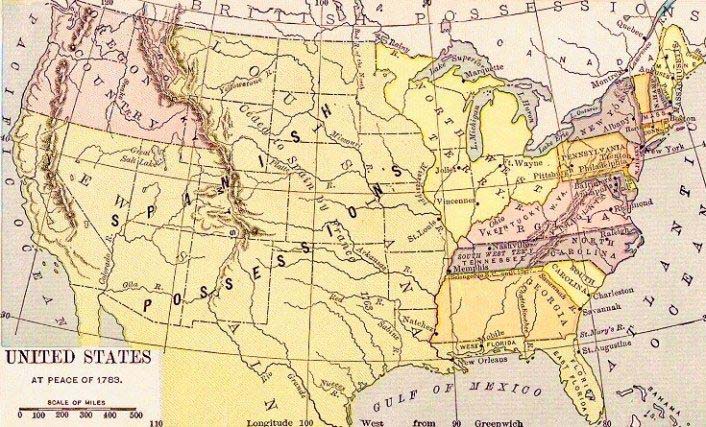
As
a sixteen-year-old Nicholas was married to a Baltimore County girl,
Ruth Acre. Their extended family was already settled in Virginia
by the time
their first
children were born (Richard, Elizabeth, William, and
Sarah). Their new home lay along the Great Wagon Road: their whole world may have
seemed to be on the
move. New settlers kept arriving in Bedford, pioneers continued
to pass
on southward. Several relatives joined and went off with the new
adventurers. Together with friends and cousins--the
Talbots, for example--Nicholas's
little family also set out to explore further down the Blue Ridge, into Rowan
County. That was a far western corner of North Carolina, which at that time extended all the way to the Mississippi
(see the map above).
Three more sons
were born to Nicholas and Ruth: Nathan, Amon and, yes,
a Nicholas. They
found the Carolina
backwoods much wilder than
the Virginia hills where their parents had
settled. They encountered
more
recent immigrants come down out of Pennsylvania, others even
directly from
Europe. Their Virginia grandparents had regarded themselves
as
Tuckahoes, proudly above alliances
with any
other than Virginia
stock. In this more diverse populace the once
familiar distinction between
gentry and servant became blurred.
Life in these parts was described just a few years later by one Francis
Baily, a young British banker who was to become a noted
astronomer. Baily reports the Carolina breakfasts
to be remarkable, not so much for the prodigious quantity as for the way all
the guests sat around the same table without regard to rank or station.
Even the prices were indiscriminate:
If our table were spread with all the
profusion of American luxury, such as ham, cold beef, fried chicken
&c. &c., (which are not uncommon for breakfast in this part of
the world), or whether we sat down to a dish of tea and hoe-cake, our
charge was all the same. The accommodations we met with on the road
were pretty well, considering the short time this country has been
settled, and the character and disposition of its inhabitants, which
are not those of polished nations, but a character and disposition
arising from a consciousness of independence, accompanied by a spirit
and manner highly characteristic of this consciousness. It is not
education alone that forms this character of the Americans: it stands
upon a firmer basis than this. The means of subsistence being so easy
in the country, and their dependence on each other consequently so
trifling, that spirit of servility to those above them so prevalent in
European manners, is wholly unknown to them; and they pass their lives
without any regard to the smiles or the frowns of men in power.
(p. 42)
Baily here hits upon that characteristic by which Americans continued
to be
recognized throughout the world. This easy social structure which shocked Baily
at the frontier did not prevail in the older colonies. It may
never have affected New Englanders at all. It certainly contributed to differences which set
the northern colonies off from the South, but it was also typical in the territories drained by
the Ohio, called the Western Waters. Baily's eye was
sensitive to the rude and sometimes filthy frontier living conditions. With his rigid British social
consciousness, he spoke of three classes, finding that the
coarseness of manners, food, and shelter was gradually refined as new
waves of settlers achieved better living
conditions. The first to venture into the wilderness had been
itenerant hunters, trappers, Indian traders, a few feral hogs. Then came pioneers able to cope with increasingly vicious
Indian resistance. They laboriously felled the huge trees, clearing the soil and tilling it for beans, corn, perhaps even a "money
crop." At last, a family could strive for a
modicum
of cleanliness and regularity.
Nicholas's parents had established such domesticity back in Virginia.
He was trying to do the same on the Watauga.
Nicholas and Ruth probably had
no memory at all of any family origins as "gentry" on the
English countryside, or as "cavaliers" in early Virginia. But they certainly
did still count themselves members of respectable society from
Baltimore County, where in time of trouble they might find shelter in their grandparents' home. Did they still carry
in their hearts that fierce resentment of absolute authority which
prevailed among Englishmen like their great grandfather when he put in on
the banks
of the Corotoman?
As we have seen, his departure from England was
intertwined
with that tragic quarrel over the people's rights vs. royal authority
which culminated in
the execution of Charles I and the exile of his son. More than a century later, Nicholas
and Ruth may have paid little heed when George
III became their king in 1760. But they did find the
Carolina backwoods governed by a ruling English elite, and tensions
reminiscent of that much earlier conflict between Governor Berkeley and
the James River rabble. If we should accept what
Baily saw as class difference between the Carolina farmers and their governor,
then we
might accurately use the
word "revolution" for the hostilities which were just about to break out.
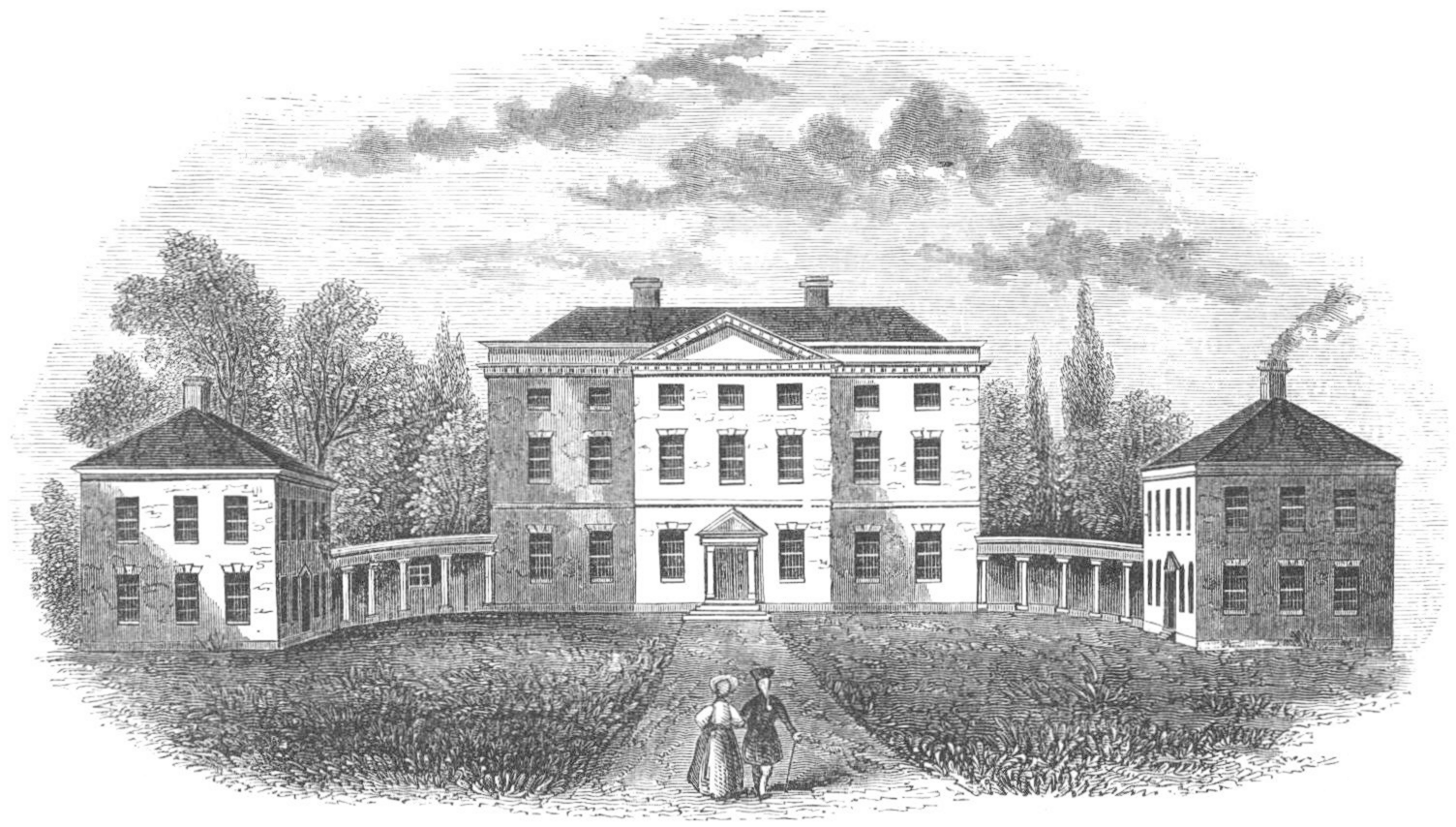
A typical object of indignation was "Tryon's Palace," as they called their governor's new residence.
Although by no
means an evil man, William Tryon's burgeoning
administrative
personnel did actually draw profit from malfeasance. The British
Parliament,
like any
government, demanded revenues. The notorious
Stamp
Act in 1765, and
then the Quartering Act (which required colonials to provide housing
and food for the Redcoats) provoked a Continental
Congress to assemble at Philadelphia. Yet further taxes
(the Townsend Act
(1767) set the stage for
the much touted Boston Tea Party up in Massachussetts.
Revolution?
The first
comprehensive history of the United States hailed this Boston fracas as the beginning of
an "American Revolution." See
The History of the United States of
America, six volumes (1849-1853) by Richard Hildreth, the
Bostonian who introduced this French term into American history writing. It was another Bostonian,
like Hildreth a Harvard
professor,
who immortalized Paul Revere's Ride. Yet another New Englander
called the
Battle of Lexington "the shot heard round the
world." History professors ever since, wistful
revolutionaries themselves, have continued to parrot
Hildreth's "American Revolution" in context with
that New England narrative.
Had Hildreth, or Longfellow,
or Emerson taken thought of the unrest a decade earlier among Carolinians --which did truly involve an impoverished proletariat
exploited by an indifferent ruling class wallowing in
alien luxury--well, then our legendary American Revolution might have
been passed down to us quite differently, and in more accurate
terminology.
As schoolchildren we might have learned about the eloquent
"Nutbush
Address," published
on June 6th,
1765 by
a North Carolina
school teacher, George Sims. Sims explains how the King's officials and legal counsel
ruin a poor
farmers
with fees and court costs alone. Sims argues that
where
there is no law, failure to comply with arbitrary demands can be no transgression. He goes
on to require "a well
regulated society [italics added]." The new Governor Tryon
threw Sims in jail. But the Nutbush line of
thought was not soon forgotten, and regulation became a popular demand. Organized resistance
emerged among Carolinians who styled themselves
"Regulators." Their meeting for redress of grievances in April of
1767 produced a list of "outrages." "Regulator
Advertisement
Number 6" from the subsequent
March 22nd
announced a meeting to "regulate" the
payment of taxes. It culminated in a written agreement where the
keynote
was:
"An officer
is a servant of the publick, and we are determined to have the officers
of this country under a better and honester regulation than any have
been for some time past." Obviously, these were people who
desired no "revolution" and disorder, but rather thought in terms
of the primary justification for any government, law and order.
On the
frontier, Americans were again and again confronted by the fundamental
problem as to how to establish such a structure to govern themselves.
It was a choice which they had not yet faced as Englishmen, nor even
during their first few generations as colonists in Virginia.
To a European aristocrat
like Sir William Tryon, a crowd suggested danger.
An assembly
for the purpose of protest
frightened the authorities. Governor Tryon
ventured out onto the sparsely populated Carolina countryside to confer with the
Regulators in the spring of 1771. He routinely brought along soldiers and some heavy
artillery. The Regulators
sent an emissary to confer with the governor's party. Tryon
ordered the emissary shot. His Redcoats then had no difficulty routing the
assembledge. It came to be called the Battle of
Alamance. Tryon hanged
several of their leaders. When he later caught up with one who
had not been present, Benjamin Merrill,
Governor Tryon used that tedious English fashion of
hanging, drawing,
and quartering (familiar to the Scots from the fate of William Wallace).
It was during these turbulant times that Nicholas and Ruth were exploring Rowan County. The Regulator disturbance had put a great fright into the
populace, so that some retreated into the Watauga valley (near present day Kingsport). The Watauga
Petition of 1776, sometimes
referred to
as
the first American Declaration of Independence, was an early effort
toward self governance at the unregulated frontier. The
John Haile whose
signature
appears on
the Petition is Nicholas's cousin.* John himself fought at Kings Mountain in
October of 1780, together with his cousin Matthew Talbot (also mentioned above). It was
the decisive
battle in the War for Independence. John Haile and Matthew Talbot called themselves
Patriots.
Needless
to say, both
had once been as loyal to their king
as were their forebears
of times past--or as were their Loyalist kinsmen whom they defeated at King's Mountain.
* Born in 1743, son of Nicholas's uncle George. This John had a
grandson named Nicholas P. Haile, who would eventually marry
our
Nicholas's great
granddaughter,
Nancy
née
Haile. She turns up a little later in these pages, the aunt of my grandfather.
By this
time the
young Nicholas Haile family was no longer at the frontier, but had already taken
refuge back home in
Maryland. The record of
their children's births enables us to judge how they had moved down to Rowan
County
during the French and Indian war, or some time after 1755, and stayed there until the Regulator
disturbances of the 1760s. But by the time their last child came
along (Joshua, in 1767), they
were dwelling at Hailes Fellowship in Baltimore.
This is where their older boys (Richard, Nathan, and
Amon) joined Washington's Continental Army in Pulaski's Legion (formed
in 1778), famous as the first American cavalry. When peace at
last
returned, these boys together with their parents and their uncles George and Shadrack, and all their wives and children, headed
back down the Blue Ridge for the Watauga.
These were obviously people who had given some thought to the uses and
misuses of the power to rule. They had overthrown the insolent
king. The
new federal
government in Philadelphia scarcely suited their taste any better than had
Royal British rule. As early as 1784, they petitioned
the North
Carolina
Assembly for an
independent
state of their own,
Franklin. Two of the signatories to this
Franklin
Petition were Nicholas's brother Shadrack (b. 1735, in Baltimore), and
Shadrack's
son of the same name. These men of the fourth and fifth
generations on American soil represent a populace now
formally separated from England. As we have seen, they had long
since acquired a
distinctive
character of their own. When they called themselves Patriots,
that reflected their classical orientation (Cicero: pro salute patriae) toward homeland or place of origin. It certainly
did not mean they were championing any American government. In
1776,
they
had signed the Watauga Petition for independence from North
Carolina's governance, and in 1787-88 they were among those refusing to
ratify the new
Constitution.
The
Franklin Petition reveals that the elder
Shadrack Haile,
born in Baltimore, still
knew how to sign his name. The son born on the frontier marks
with his X. The father may still reflect something of the
old Tuckahoe
culture and attitude, but both he and his son are now obviously
post revolutionary men. The Franklin Petition expresses the now
characteristic American rejection of any remote authority. This same abhorrence
of a
national power divided the
Constitutional Convention in Philadelphia during the long summer and
fall of 1787.* It continued to characterize the southern and
western
states. Vestiges are still apparent in national elections of
the
twenty-first century.
*By all means re-read Miracle at Philadelphia by Catherine Drinker Bowen, 1966.
Nicholas's last will and testament was
not
made out until April of 1807. Even then, more than a decade of
life
remained to the old boy (he was to outlive the youngest son mentioned in his
will). Here is the best place for it, however, since it still
reflects ways and mores of the 17th and 18th
centuries.

top

bottom
Senr of Washington County and state of Tennessee
being of a Sound mind & memory thanks be to almighty God
Do by these presents make and ordain this my last
will and testament in manner following viz.
first as I have given to my Six Sons Richd William
Nicholas Nathan Amon and Joshua Haile
Heretofore their full portions in land & other property
& So my will is my Six Sons above mentioned to Receive
one Dollar out of my Estate each of them & no more
Secondly after all lawfull Debts being paid
my will is my three Daughters Elizabeth Cage
Ruth Haile & Sarah Gray to have the Remainder of
My personal Estate to be equally divided among
those, thirdly a certain tract or parcel of land laying
Between Thomas Murrys line and Thomas Barrons line
and Michael Eddlemans line Supposed to be between
Eighty and Ninety acres to be equally Divided between
the Heirs of John Haile Deceasd and Reason for this
is the said John Haile Died Intestate-------
Being a piece of land I gave to my Son Amon Haile
& he Sold it to the Said John Haile & they have never
had any title from me for it yet so my will is
To leave it as above---
Fourthly, my will is that my mulatto man Bob at my
Death be set at his liberty & become a free man --
Except there be a Crop on hand & then at the Coming in
of the Crop to be set at his liberty --
fifthly my will is that my son Richd Haile have the
whole managing of my affairs. Wherefore I Set my hand
and seal this 29th day of April 1807--
Witnessed
George Parkinson
Nicholas Haile
Rowland Derry