<
PREVIOUS
V.
The New Republic and its Western Waters
The Haile
boys who served
under George Washington had interest in a major issue
before the new government in Philadelphia: its debts to the
veterans from the War for Independence. How to raise such a
vast amount of money? --or whether even to try? So long as
the
revered general was Head
of State,
factionalism remained furtive, and partisanship was
despised. Just as
soon as the first president stepped down, however, a division
emerged on this question as well as other powers of the president.
There were those
who favored the strongest possible executive, as had Washington
himself.
Washington's
successor, John
Adams, and especially Washington's favorite, Alexander Hamilton, felt
the same way. Hamilton even argued for a national bank, so the government could pay its bills. Theirs was the
so
called Federalist
view. It appealed to the commercial class in New
England, who had business interests abroad and were inclined
toward reconciliation and peace at home. After the long summer's debate and compromise, their championship of strong
government had finally prevailed at the Constitutional Convention.
Farm families like the
Hailes, on the other hand, were still apprehensive of rulers under whatever guise, and
jealous of local control. They had little interest in
Europe. At home, they were still in mortal
combat with the Indians and had not forgotten frequent Indian alliances with the
Redcoats.
As the
Franklin Petition shows, Tennessee
settlers wanted no part in a
federal government. They certainly did not want to
hear of Hamilton's national bank. Their own experience confirmed
Thomas Jefferson's
objection
that the veterans had
already sold their claims to speculators for cash money, anyhow, and at
a
discount. Anti-Federalists
looked for leadership to the eloquent author of the Declaration of
Independence. They shared his admiration for the revolutionary
new
republic in
France, and also called themselves Republicans.*
*to
the great annoyance of academic historians 200 years later, who coolly
renamed Jefferson's party "Democratic-Republicans"--never
mind that in Jefferson's day "democratic" was still pejorative.
It is possible that these historians are just confused by
radical groups who called
themselves "democratic-republican" back
about 1794.
President Adams felt
threatened not only by these home grown Republicans, but by the
Republic of France, too. In 1798, his
administration won extraordinary
powers to shield against French immigrants and French sympathizers, the Alien and
Sedition Acts. Thomas Jefferson and James Madison feared he political pendulum had swung in favor of a strong government. The Kentucky
Resolution
and the Virginia
Resolution (both in 1799) declared the Alien and
Sedition Acts null and void, as beyond the
powers of constitutional government.
These two resolutions were an early assertion of state rights, and
even raised the prospect of a state's withdrawal from the recent
Union. Especially southerners were suspicious of
wealth and power concentrated in government. Nonetheless, Alexander
Hamilton's
proposal
did prevail, the national
debt was honored, and John Adams's presided over growing strength in the
infant republic. But it was still at a fork in the road. Was America now
to grow into the
powerful nation Washington, Hamilton, and Adams envisaged?
Or would a free citizenry remain
beyond the reach of national taxes and federal compulsion? When Jefferson was elected president in 1800, the pendulum swung back, as frontier families like the Hailes saw things, in their direction.
Federalists, on the other hand, were anxious that Jefferson's election portended
the
passage of national leadership away from New England, whose primacy went back to the fabled Puritans on the
Mayflower. How different seemed these cavalier Virginians, who even cultivated good relations with
the French. France's need for money to prosecute their war against England enabled President Jefferson to achieve the
Louisiana Purchase Treaty, perceived by New England as yet further
diminution
of her
influence. Debates about the vast new territory revived and
aggravated the rift between north and south. Jefferson had
long looked upon public lands as a resource for meeting public
debt, but he also envisaged them as free from the curse of slavery.
After
Jefferson's two terms, his Virginia protégés succeeded
him, first James Madison and then James Munroe. Still aligned with France, Munroe finally fell into open conflict with Britain. This time
the national force was opposed by those quondam supporters of it, the
merchants in New York and New England. They still
valued profitable relations with England and with American Indian
tribes, of course, and now they were sure Madison's 1807 embargo on
Atlantic trade would ruin them. Connecticut
outright nullified the president's embargo as unconstitutional. This first standoff between north
and south came to a crisis in the War of 1812. Massachusetts,
Connecticut, Rhode Island, New Hampshire and Vermont met to consider secession and a separate peace with England (the Hartford
Convention). Only Andrew
Jackson's unexpected victory at New Orleans resolved the crisis. By this
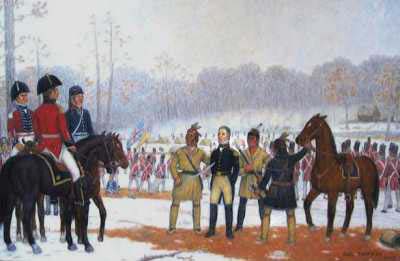
time, the war had already taken Nicholas's youngest child, fighting
Indians and Redcoats in
Ohio.
Kentucky and Tennessee Volunteers