By
the
middle of the eighteenth century the
Talbots, the Meads, and the Hailes were settled in Lunenburg County,
Virginia (in the region which later became Bedford County).
That they here became active in the Baptist Church suggests
assimilation into the frontier society and perhaps alienation from high
church aristocracy. They held various county
and
municipal
offices. Nicholas Haile served as County Justice in 1749, William
Mead took up surveying, became a county official and lieutenant in the
militia. Eventually he acquired the rank of colonel in the
Continental Army. Talbot and Haile undertook a grist mill on what
is still called Hale's Mill Creek. In about 1752, Nicholas's
widowed daughter Mary married Talbot's son Matthew jr.
(1729-1812). In 1750, Nicholas Haile was charged to draw up a List of Tithes for Bedford
Town. It includes
his inlaws the Merrymans as well as another Baltimore family, the Wheats, who now
resided at Haile's Fork of the Otter River, as it flows through
Bedford town.
Although they still looked back
to Baltimore County as home, the Nicholas Hailes had now removed well
beyond the fall line of the James and the Rappahannock into
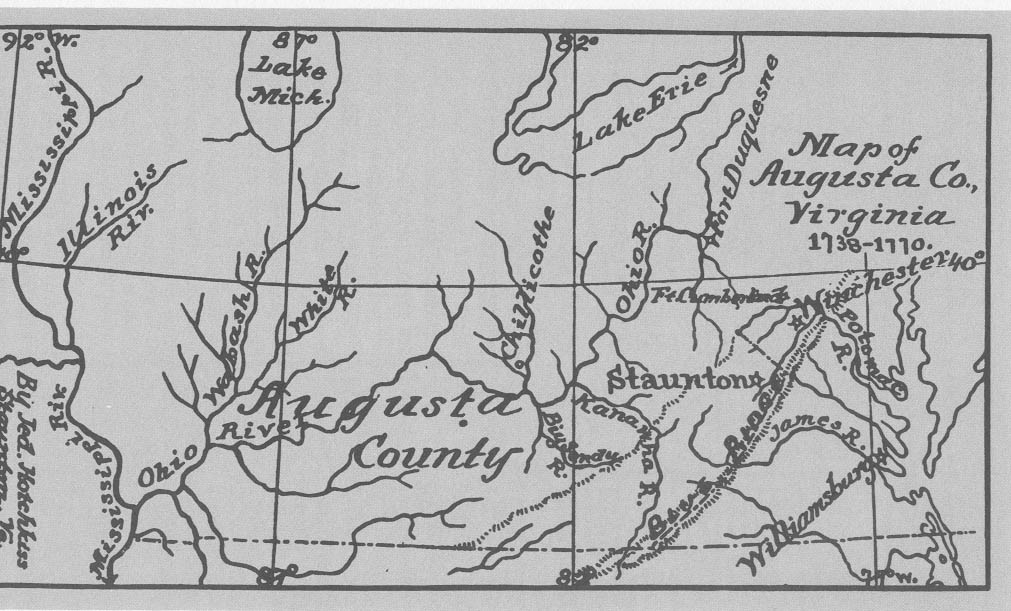
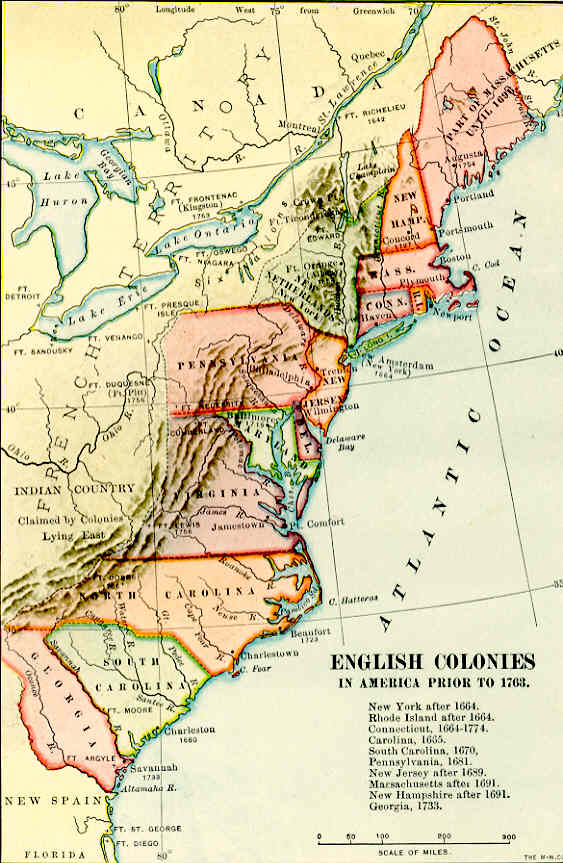
what they called Augusta County. In 1716 Governor Spotswood
had followed Indian trails
into the back
country. He named the territory after George II's mother,
Augusta of Saxe-Gotha. Augusta County It extended all
the way to the
Mississippi River in those days. It lay on the path of the
great
migration
out of Pennsylvania down the Blue Ridge into the Carolinas, called the
Great Philadelphia Road, or just the Great Wagon Road.
Quakers were not the
only dissenters settling here. Presbyterians had shipped to
Pennsylvania as well. Although originally Scots,
they were called Scots Irish because, after their defeat by the
Royalists at Worcester (1651) they had been
exiled to Ulster. Among them was a
McClure family, my maternal
forebears, still very conscious of their Scots poetry and song. Venturing south on the Great Philadelphia Road, these
people entered
the
Shenandoah Valley via Staunton. Here lay a
vast tract
which in 1736 had been granted in the name of George
II to William
Beverley on the condition that Beverly induce permanent
settlers into the back country. Beverly had been a companion of
Governor Spotswood in exploring the wilderness. The idea was to bring
settlers into the backwoods as buffer to shield the Tidewater against
Indian (and French)
incursions. The McClures
must
have struck Beverly as
substantial folk. Although he had put
land up for sale at ₤ 1 sterling per
40 acres, the McClures appear to have got it at a tiny fraction of that.The first known
schoolhouse in Augusta County
was on James McClure's tract "at the foot of a hill in the meadow."
James became a charter
member
of the
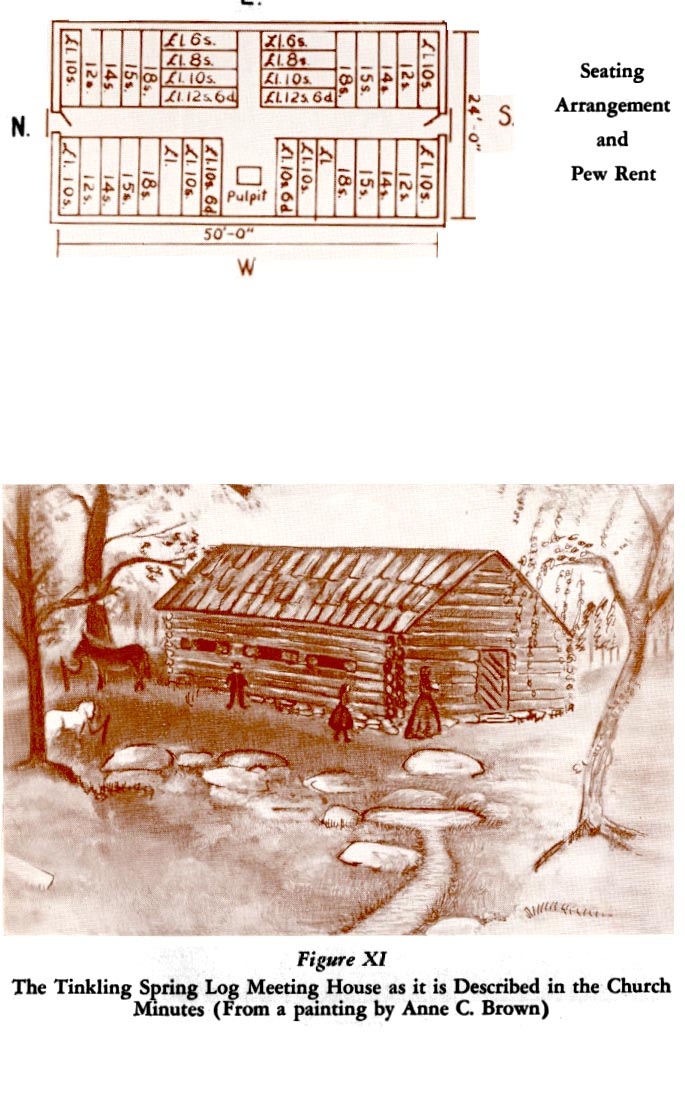
Tinkling Spring Presbyterian Church at its founding in
1740. One of the church's
first
tasks had been to obtain a Presbyterian minister from back "home" in County Donegal,
the
thirty-year-old John Craig.
His church is still thriving, situated near the
Fishersville exit from I-64 on the way into Waynsboro . A few miles on east of the church
flows the South River, along which young Andrew McClure took 370 acres
in
1738. Andrew was the son of James, who bought an
adjoining 408
acres in the next year, and another
359 acres ten years later.
This James McClure (1685-1761) had been a tailor in Raphoe, County
Donegal, as was his father, James Arthur McClure, who never made it to the New World: he died at sea in
1732. His death no doubt occurred aboard the same ship which brought
the old man's son and daughter-in-law, Agnes, as well as his seven
grandchildren into Delaware
Bay. If so, then the McClures' half-dozen years in Pennsylvania prior to
the
records of the Beverly Grant remain unaccounted for. These may not have been
the only McClure family among the Scots Irish emigration to
Pennsylvania.
The James McClure school
at Tinkling Spring illustrates
a second stage in Virginia education. We have seen the first stage in Tidewater families
like
the Hailes, for whom education lay within the legal
framework of the apprenticeship and indenture contracts. The
guardian often required
tutors, and may have even called upon traditional Latin schools. Nicholas on the Corotoman was required by law to provide schooling for every bonded servant he brought over.
The McClure
school, on the other hand, was a community effort. These
battered Scots Irish had been repeatedly
torn from accustomed surroundings in England and Scotland,
they had been exiled in Ulster for three generations (the Battle of Worcester was in
1651), had endured a grueling,
months-long North Atlantic crossing, and spent some years toiling in the Pennsylvania back country. Now their immediate
concern
in the mountain
wilderness was for spiritual guidance. James
McClure's rôle as schoolmaster in Tinkling Spring may say something
about this Donegal tailor's intellectual stature in the community,
but above all it is evidence of frontier preoccupation with the transfer
of culture to their children. The intellectual content of their religion made them quick to call a
preacher from home in County Donegal.
The spot where the McClures settled in the Shenandoah Valley
lay just beyond the Blue Ridge from
where Nicholas and Anne Long Haile were to establish their new
home.
A folk song from those days suggests the Hailes' impression of
the culture they encountered here:
Turkey
in de straw, turkey in
de hay Turkey
in de straw, turkey in de hay
Roll 'em up an' twist 'em up a high tuc-ka-haw
An' twist 'em up a tune called Turkey in the
Straw
Turkey in the straw--haw haw haw Turkey in the hay--hey hey hey
The Reubens are dancing to
Turkey in the Straw.
One might guess "The
Reubens" to be what we call "rubes" today. For the Hailes, the
word may have carried an overtone alluding to the Bible (the eldest son
of
Jacob). Whether biblical or not, the Reubens are such hicks that
their dancing is an awkward affair. And what is a "tuckahaw"? I guess it
to be the Indian word
"tuckahoe," here used (as recorded in Webster's) as a nickname for "a
Virginian living east of the Blue Ridge mountains." Actually,
Tuckahoe
is also the name of the river on which the Randolphs built a mansion of
the same name.
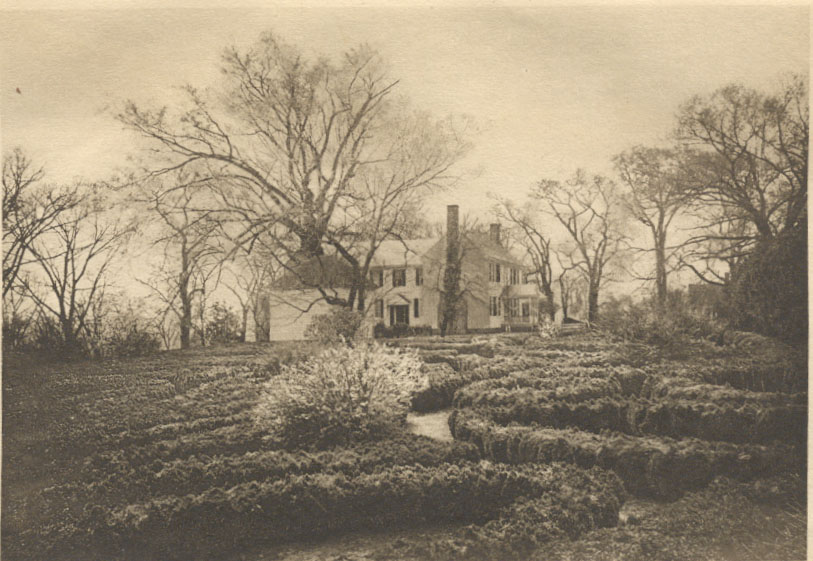
Tuckahoe
Tobacco
plantation of the Randolphs, acquired by Thomas Jefferson. The
name became a Virginia term for the tobacco aristocracy in
general.
In the song, a "high tuckahaw" has to be something you can
"roll up and twist up." It probably just means a fine tobacco
leaf, a cigar. The Virginians who used the term Tuckahoe for local aristocracy had
another word for "the Reubens": Cohees.
The Cohees were
Bible-quoting
("quoth he") grain
farmers of Presbyterian, Quaker, Baptist, Methodist, etc.
faith--just like the McClures at Tinkling Spring.
Nicholas and Anne Haile probably still regarded
themselves as Tuckahoes from Baltimore County. That is where their
youngest child
was born in 1743. But by the time
their eldest
daughter
married
in 1750, Nicholas and Anne
were in Bucks County, Pennsylvania. Their subsequent
trek down
the Great Wagon Road to Bedford occurred just at that
perilous time
when the colonists
were being drawn into England's
quarrel with France, and the French were
allied with the hostile
Delaware Indians. At a
battle on the Monongahela in the summer of 1754, the Delaware
defeated
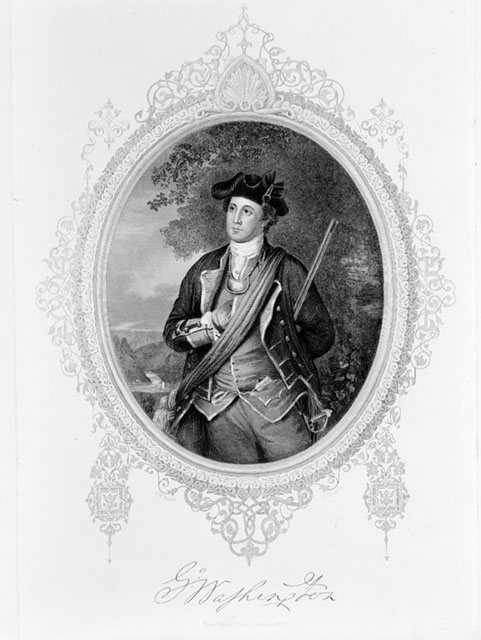
young Colonel George
Washington. Their
subsequent
ambush and destruction of General Braddock's forces at the fork of the
Allegheny now posed a dire threat to the entire route
along which
families like the Hailes and McClures were settling. The formidable
Delaware
were not alone. In
the same month as Braddock's defeat (July, 1755) the Shawnee massacred
a frontier Virginia settlement and robbed a young mother, Mary Draper
Ingles, from her home. While
her captors were rushing
her down the Ohio River, Mrs. Ingles gave
birth to a
little boy. In Indiana she finally made her
famous
escape. If her infant son survived, he was left behind with the Indians.
Mary Draper Ingles' trek back home was long and arduous. She had
no
choice but
to follow the great River. Wherever a tributary might flow into the Ohio,
she had to
detour in search of a crossing. Her travail
culminated in her successful return home in December. Contemporary
correspondence (below) concerning
nearby
Bedford offers another
perspective on the Indian problem.
Royal authority held Virginians to a scrupulous forbearance , even in the face of Indian depredations. In
an attempt to enforce British policy and to shield the colonists,
Colonel Washington
founded a "chain
of
forts" from Maryland along the Blue Ridge down into Carolina.
Among Washington's
correspondence are letters from John Blair (1731-1800), president of
the Council in Williamsburg.*
In writing to Washingon, Blair encloses letters from two colonial defenders against the Indians,
Matthew Talbot and William Mead. Since both these men are inlaws
of Nicholas Haile, we have to assume that the Haile household was among
those upset by the Indian troubles depicted here below. *Blair was later to become one
of
the signers of the Constitution and, after Washington became President, a justice of the United States Supreme Court. In May of 1758, young Blair
wrote to Colonel Washington on the subject of funds
and recruits for the colonial militia. As he was writing, more
pressing business arose. He reports:
Last
Saturday brot. me an Accot. of a large party of Indians who in passing
thro' Bedford spread themselves in smaller Companys many Miles wide and
Robb'd every Plantation they came at. This provoked the
Inhabitants to a great degree; Col: Talbot sent out Militia to protect
them, who came up with a Party of them and seeing some of their Horses
demanded restitution; but the indians answered they must fight for
them, and fired and killed one Man; whereupon they fired upon the
Indians and killed some of them. But to save my writing I
send you the accounts I received, having ordered a strict enquiry to be
made above, by Col: Read, Colo. Talbott and Col. Maury, which when
transmitted to me I purpose to send by express to Govr. Lyttleton to
beg his Assistance, to prevent the disaffection of the Nation and the
ill consequences that might ensue on a misrepresentation . . . You may
assure them if our Men were the aggressors they will be severely
punished and if the Indians were guilty of what is charged upon them
the Wise great Men our good Friends will not blame what was done, but
think they brought it upon themeselves by their own folly. . . .
I am Sir Your very humbl Servt. . . .
John Blair The Colonel Talbot whom Blair mentions is Nicholas Haile's
partner, Mary's father-in-law: William Talbot, age
fifty-nine.
The first of
Blair's enclosures is Colonel Talbot's letter addressed
to
the
clerk of Lunenburg County on May 3, 1758. Begging
for reinforcements. Talbot writes
I do everything I can to keep
a few men out on the frontiers of this Countybut alass I fear it will not be long they
wil Continue indeed it is very hard for men to be from there
plantations at this time of the year when they Should be planting Corn
to make the bread for their families . . . I am very uneasy
about the Cherokees there was about fifteen Came through the
Settlement where I Live and Spread themselves at least ten miles in
breadth and went to Every plantation in their way I Cant Say they did
much mischief or behaved very ill but their presence frithen the women
very much So much that if they be allowed to Come without white men . .
. with them I do not blieve our County will Stand a month Longer
there Came about nine or ten to my house they reley Seemd to me as if
they Came to See what white men and negroes we have and so see what our
Strengthe we are of, the people in general Seem to fear the return of
them with more force they made for Stanton [over the mountains,
about 50 miles north] they went to a
house where there was not any body but a man and his wife and rensacked
the house of every thing they thought Proper to take and I expect to
hear of Some murder Committed by them when they Get to the outward
Inhabitants . . . My son Matt [ths is Mary's husband] is endeavoring to raise men to goe out
after the Indians and to lie in wait for them and tell me he is
determind if it be possible to goe till he get Some of there Scalps and
or Leave his he imagines to get about five and twenty men . . . he will
have none but what is Select Gunners and . . . good woodmen I know he
refuses Several who offer to goe because they are not Such he seems to
be very ambitious that way and I Cannot forbear incouraging him in it .
. .he will leave his wife and Children with me or at Charles. . . .
MATTW. TALBOT
As the marauders moved north, they would threaten settlements
around Winchester, where the Crank family was now located. By
"outward inhabitants," Talbot means people like the McClures who had
been
brought into the back country as a buffer against the Indians.
The Beverley Patent lay at that gap in the Blue Ridge which would enable these
Indians to pass as "they made for Stanton [Staunton]."
Blair had also received a
note of distress from
William Mead (Anne's husband), dated May 8th--
With Sorrow I inform you . . . that
the Indians has taken all Thos. Morgans family and all are Carried away
or killd. and all the Goods Carried away and destroyed and it is the
opinion of the men that Some are Killd. by the Signs they Saw--and as
you render the Good of your Self and Country beg youl Send men
immediately . . . to relieve the Poor distressed Prisoners . . .
WILLIAM MEAD Blair
also told Washington of a pitched battle on May 10th,
and enclosed a report
from Col. Talbot to the county clerk:
DR.
SIR in
what Manner Shall I Represent to you the Horror and anxieties that
at this time reigns among our Inhabitants (indeed as I have not words I
must be Silent and Leave it to your imagination). Occasioned by
these banditties of Cherokees who daily are traveling through our
County . . . they Rob our houses of all things they Like So that
oftentime they Leave us not one rag of Cloaths to Shift our Selves
withall nor never a horse to goe mill or plough withall, yet these
people are Called our friends our people will bear it no Longer Indeed
I
think they have bore it to Long allready and I do not know but the
persons who have exerted them Selves in defence of their rights and
properties may be Called to a Strict account for it [he cites some examples, then
returns to his own experience] Last
Sunday there passed by 33 Indians in another parcel which Robed and
pillaged as they went Capt. Mead [Anne's husband] with
Seventeen men went in pursuit of them and wrote to me to beg I would
Send him Some assistance . . . and if they Come up with the Indians as
I expect they will and the Indians will not deliver the Horses and
other things they have Stole a Battle will insue for our people is
determined to bear Such usage no Longer . . . I beg if this Come to yr.
Hand before you Send to me that youl be so good as to Send Isham [Matthew's 20-year-old son by
a second marriage] up to me
to be Some assistance to me in these troublesome times for I am very
much afraid I must move my wife and what Small effects to some place of
Safety and I wish you would be pleased to Look out for a west house
a Small one would do for my wife and I though I will be hear as Long as
I
Can Yr. Complyance will Greatly
oblige Dr. Sir yr very Hble
Sert. MATTW. TALBOT
Ps SIR I beg youl Hasten up what men you design for our relief Dr Sir I
beg youl Let Isham Come up to me directly and be So good as to Send me
a 100 flints and if you have not a horse to Spare Let him Come afoot
the Bearer if you order him will goe to Wmburgh with the Letter to the
President--I this minute Recd yrs by Hicks and alas See our frontiers
(as you observe) is Little regarded . . . if I had the Eloquence of
Cicero I Could not tell you the anxiety of my Soul at this time for my
Self family and Inhabitants here--Keith Daughter is dead Likewise I am
informed to day that Bruff wife is Likewise dead.
Among other
entreaties, Blair sends along to Washington letters from the colonel's
older son, Charles (Charles and Matthew, Jr. were thirty-five and
twenty-nine at this time).
Marauding Indians were a fairly typical circumstance all along
the
mountain ridge down to the Carolinas. Nicholas's younger
brother George (b. 1712) moved his large family from Baltimore the same
three hundred
miles down to Bedford County (then still called Lunenburg) in
Virginia. From one of George's
Tennessee
grandchildren we
learn that the family purchased eight Irish bondsmen in Baltimore, and
took
them along to the Watauga (Crowe, p. 31). This was exactly the
way the
family had come to Virginia a hundred years earlier, first providing
themselves with the labor to develop the land they hoped to acquire.
Another of my
maternal forebears, the
Crank family,
were Tuckahoes who moved upriver past the fall line, then down the
Great Wagon Road through Cohee country. Originally the Cranks had dwelled
just across the Rappahannock from tdhe mouth of the Corotoman (where Nicholas Haile farmed). From there, Matthew Crank's son
Thomas (1735-1782),
m. Elizabeth Richardson (b. 1745) moved upriver into
Goochland County. Their youngest child, William (1772-1854) m.
Tabitha Poindexter (1775-1854), can also be traced by record oftheir children's births: a
daughter and two sons upriver in Louisa
County; then a third son down the Blue Ridge
in Amherst County, adjacent to Bedford, where the
Hailes had located. By the
time of
Thomas Jefferson's
administration, the Cranks had moved all the way down to the North
Carolina border in Halifax County.
I can scarcely help
wondering whether my various kinfolks had not made acquaintance in
those days.
These were people of similar background who shared the same
hopes, had similar means for accomplishing them.
Furthermore, they were all of English stock, often of
the same English culture. They were following the Great Wagon Road southward, an extension of the Philadelphia
Road which the McClures had taken down out of Pennsylvania. They were spending their lives among a burgeoning German population, as place names attest today
still. Yet for these English and Scots Irish there appears no intermarrying with the Virginia Germans. Later
Crank generations eventually moved to
Arkansas. This is where young Elisha McClure took Mary Crank to
wife. Two years later, Elisha's older sister married Mary's
brother (Robert). Then finally Elisha's younger brother (Daniel)
chose Mary's
sister Martha.
The profusion of double cousins bespeaks also how families clustered
together in the wilderness, if only for
safety, but probably to preserve its own traits, each after its
kind--as the settlement at Tinkling Spring had sent back to County
Donegal for their preacher. To preserve their Christian
heritage, they became active in denominations which displaced the
Church of England. And now in Arkansas, after more
than a century in America,
the Tidewater
English
Tuckahoes were finally mixing
with back-country
Scots-Irish
Cohees..
One destination for the Hailes
was to be the
Watauga
region of what was then North Carolina. Mary's husband,
Matthew Talbot,
became a very large
landholder both in Virginia
and on the Watauga. Although Talbot, like his brother-in-law
young Nicholas Haile, had been raised in the
Church of England, he too became a Baptist preacher. He founded a
church on Sinking Creek.
His was
the generation drawn up into the War
for Independence, beginning here already in the 1760s. Talbot built a fort
on
his Watauga property which served as staging ground for the Battle of
Kings
Mountain (1780), in which he fought. Matthew's oldest son, Haile Talbot,
moved out to
Missouri, where he became involved in the Missouri push for statehood.
In
subsequent
Talbot generations, Hale / Haile continues to recur as
given name,
sometimes as
a
middle name for the girls.
Anne's husband, William Mead, was a
prominent figure in the development of New London (about 15 miles east
of Bedford). This is the Colonel Mead in the Washington
correspondence above, an
important defender of New London. He was already an experienced fighter, having figured as a youth in
the
campaign at Fort DuQuesne (1758). Like Matthew Talbot, William Mead would go on to serve in the War
for Independence. Anne bore William seven children before her
death
in
childbirth. Mead then married the widow of
his sometime boss William
Stith (chief surveyor in Bedford) and fathered six more
children. Having accumulated immense
land
holdings, Mead at last moved to Georgia, where he again accumulated
large
estates.
Nicholas's
name, on the other hand, ceases to turn up in Virginia
records,
even as records are
now becoming
more abundant. We must assume that Nicholas did not survive his fifties, since his wife returned to
Baltimore and remarried there in
1760. Perhaps problems
of health had already contributed to his restlessness, even to his
religiosity--but that is pure speculation. While Nicholas's son-in-law, offspring of Quakers, went on to
a
very worldly and warlike career, Nicholas's own son
(Nicholas, included in the Bedford
County tithes mentioned above) founded a Baptist church in
Watauga, as had his brother-in-law Matthew Talbot.
The Indian troubles
these fellows
describe
in their letters certainly put a great fright
into the Scots Irish settlers up at Tinkling Spring, where a general
exodus was
prevented only by the stalwart encouragement of their Reverend John
Craig. Samuel McClure was one of several
who did foresake the Tinkling
Spring Community. By 1757, Samuel had made it as far south as Hanging Rock Creek,
just
across the border
from North into South Carolina. In that
year he married a local girl, Sarah Rankin. Samuel, James
McClure's youngest son, had become father to his family's
first
child
born
in America. The peace loving qualities of Samuel and his kin
would make them especially vulnerable to impending conflicts in the
Carolina backwoods. Samuel's
children remained at Hanging Rock
Creek
until after the War of
Independence.